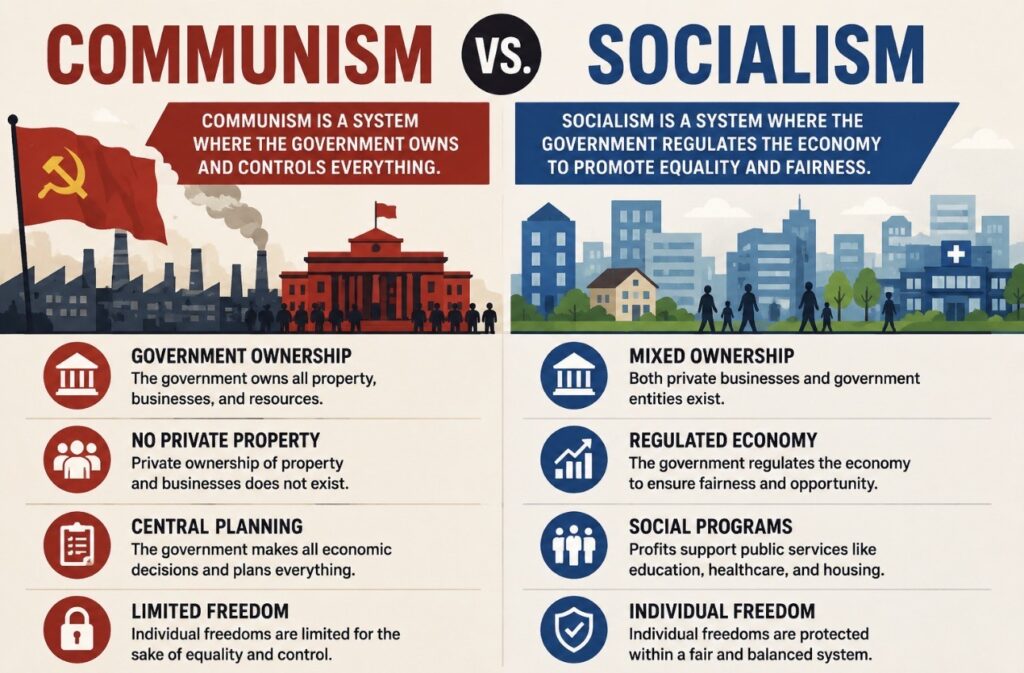
The words communism and socialism are often used interchangeably in political conversations, but they describe different ideologies. Although they share historical roots and both challenge concentrated wealth and economic power, they differ in their goals, economic systems, and views on private property and government. Understanding the difference matters because these terms often shape political debates and are sometimes used inaccurately.
What Is Socialism?
Socialism is a broad political and economic ideology that generally argues that important parts of the economy should be owned, regulated, or controlled collectively rather than controlled entirely by private individuals or corporations.
Socialist systems can take many forms. Some call for government ownership of major industries, while others support a market economy combined with extensive public programs and regulations designed to reduce economic inequality.
For example, a country may have privately owned businesses while also providing publicly funded health care, education, unemployment assistance, or other social programs. These policies are sometimes associated with democratic socialism or social democracy, although those terms have distinct meanings.
The central idea is that economic resources and opportunities should be distributed more equitably and that society has a responsibility to provide a basic level of economic security.
What Is Communism?
Communism is a more specific and revolutionary ideology, most famously associated with Karl Marx and Friedrich Engels.
In The Communist Manifesto, published in 1848, Marx and Engels argued for abolishing capitalism and eventually creating a classless society.
In the theoretical communist model, major productive resources such as factories, mines, and large-scale agricultural land would not be privately owned for individual profit. Instead, they would be collectively owned.
The goal of Marx’s theory was a classless, stateless society in which economic resources would be shared according to the needs of the population. However, governments that have historically identified as communist including the Soviet Union, Mao-era China, Cuba, and North Korea have generally operated as highly centralized states rather than achieving the stateless society described in Marxist theory.
The Biggest Differences
One of the easiest ways to understand the distinction is to compare how each ideology approaches several key issues.
| Issue | Socialism | Communism |
| Private property | Private property can exist, though some industries or resources may be publicly or collectively owned. | Major productive property is collectively owned in the traditional Marxist model to eliminate class divisions based on capital ownership. |
| Role of government | Socialist systems can operate within democratic governments and coexist with elections, parties, and private businesses. | Marxist theory ultimately envisions a classless, stateless society, though historical communist governments have usually been highly centralized. |
| Capitalism | Some forms seek to replace capitalism, while others retain significant market activity. | Marxist communism seeks to move beyond capitalism entirely. |
| Economic equality | Generally seeks to reduce inequality through collective ownership, taxation, regulation, public programs, or redistribution. | Seeks to eliminate the class system by ending private ownership of productive capital. |
It is important to distinguish personal property, such as clothing, furniture, or other belongings, from private ownership of productive capital, which is what Marxist theory primarily addresses.
A Simple Way to Remember the Difference
Think of it this way: socialism generally focuses on greater collective ownership, public oversight, or shared control of economic resources in order to reduce inequality. Communism, especially in the Marxist tradition, goes further by seeking to eliminate economic classes and ultimately create a classless, stateless society based on collective ownership.
Neither term describes one single political or economic system. There are many forms of socialism, and communist theory that has been interpreted and implemented differently across countries and historical periods.
What About Social Democracy?
This is where political discussions can become confusing.
Social democracy is not the same thing as communism.
Social democratic systems generally maintain a capitalist market economy while using taxation, regulation, labor protections, and social programs to provide greater economic security and reduce inequality.
Countries such as Sweden, Denmark, and Norway are often described casually as “socialist,” but their economies are better understood as capitalist mixed economies with extensive welfare states.
The distinction matters because government-funded health care or strong social programs do not automatically make a country communist—or even socialist.
Are Communist Countries and Socialist Countries the Same?
Not necessarily.
The terms describe different ideological traditions, and countries can incorporate elements associated with socialism without being communist.
Historically, governments that called themselves communist often claimed that they were building socialism as a transitional stage toward communism.
That connection is one reason the terms became closely linked during the twentieth century.
At the same time, many modern political parties and movements that identify as socialist support democratic elections, civil liberties, private businesses, and mixed economies.
Why Does the Difference Matter?
Political labels have consequences.
When socialism and communism are treated as interchangeable terms, political discussions become less accurate and less informative.
A person who supports government-funded health care, stronger labor protections, or higher taxes on wealthy individuals is not necessarily advocating communism.
Likewise, someone who identifies as a socialist may support democratic institutions, private businesses, and a mixed economy.
Understanding political ideologies requires looking beyond labels and examining what a person or political movement believes about government, markets, private property, individual rights, and economic power.
The Bottom Line
Socialism and communism share historical connections and concerns about economic inequality, but they are not identical.
Socialism is a broad family of political and economic ideas that can include collective ownership and extensive social programs while sometimes keeping markets and private businesses.
Communism, particularly as developed in Marxist theory, seeks a classless society based on collective ownership and ultimately envisions the disappearance of the state.
Knowing the difference helps citizens have more informed conversations about political ideas and evaluate political claims based on facts rather than labels.
Sources
- Karl Marx and Friedrich Engels, The Communist Manifesto (1848)
- Stanford Encyclopedia of Philosophy,
“Socialism” - Encyclopedia Britannica,
“Socialism” - Encyclopedia Britannica,
“Communism” - Library of Congress, resources on socialism, communism, and political thought